
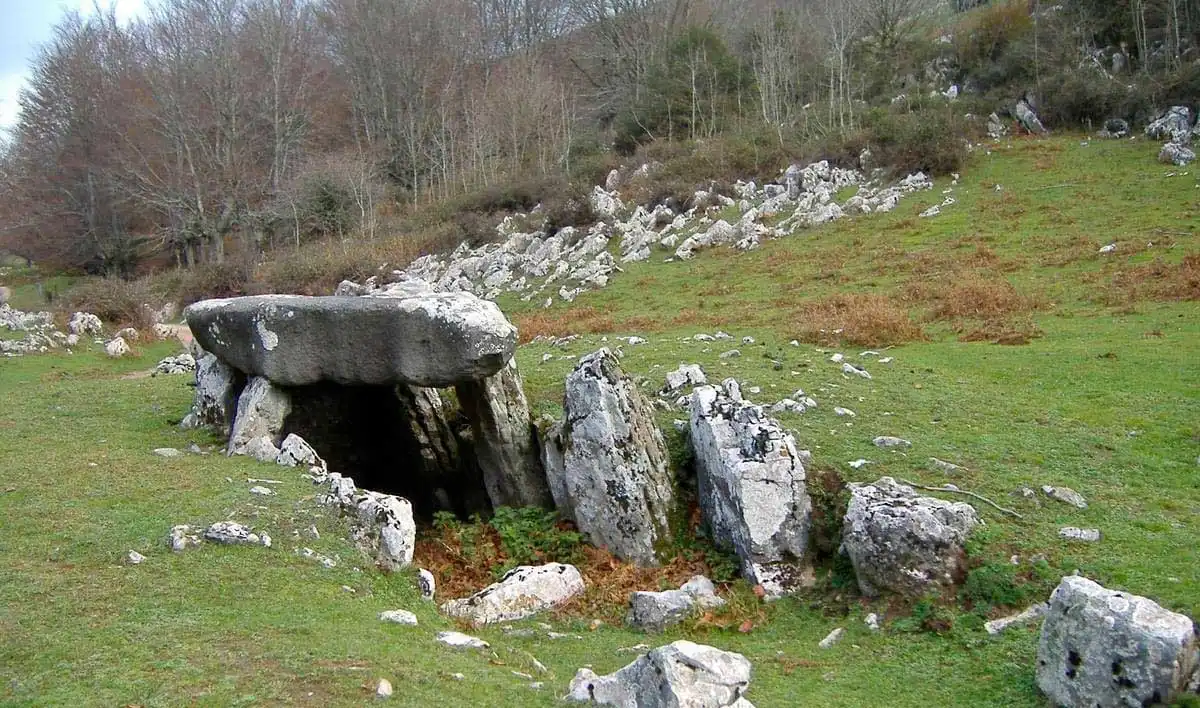
A tradition supported by certain historical evidence holds that the site occupied by the sanctuary, on the ridge of Putregain, has been a sacred place for various cultures for thousands of years. The fact that the Aralar mountain range is home to an extensive collection of megalithic monuments dating back 5,000 years suggests that the sanctuary site itself may have originally been home to a principal dolmen at the dawn of pastoral history.
Later, Romanization would adopt the sacred character of this summit, mons excelsis, and build on this hill, visible from the plain, the ara coeli: a temple erected in honor of the Roman gods who protected travelers along the Roman road that crossed the Araquil Valley. This road connected Bordeaux with Astorga and, after crossing the Pyrenees at Ibañeta, passed through Pamplona and Irurtzun before heading toward Vitoria, leaving the Aralar range to the north. The Itinerary of Antoninus Pius mentions the station of Aracoeli, the Aracelium or Aracillum referred to by Florus and Paulus Orosius. It is generally identified with Uharte-Arakil, from which the site of the ara coeli is clearly visible.
The first Christians are thought to have transformed the emblematic Roman complex, and the earlier dolmen site, into a place of Christian worship.
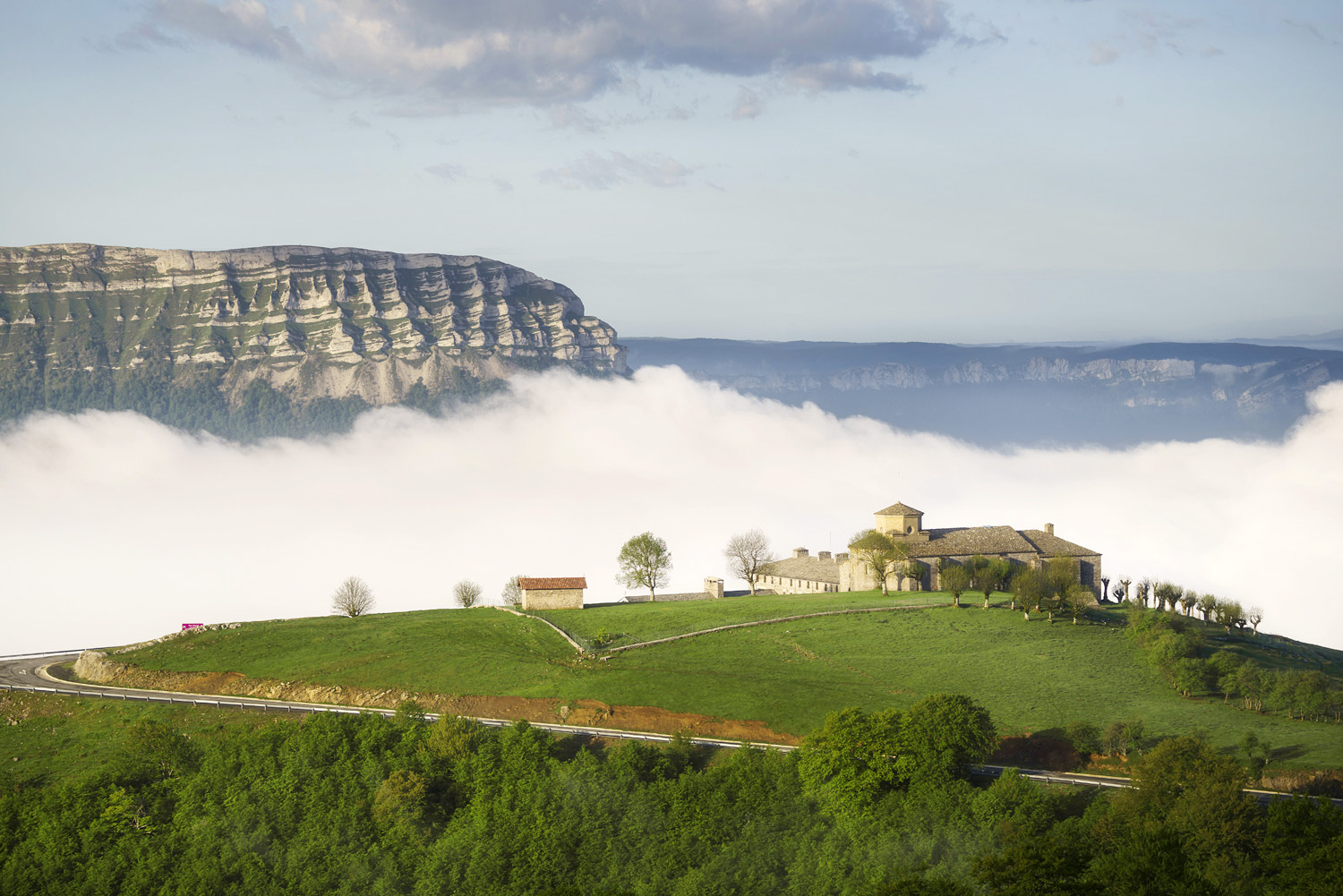
The earliest historians of the Kingdom of Navarre do not mention the apparition of Saint Miguel to Teodosio de Goñi as the origin of the Aralar sanctuary. This account took shape during the early modern period. The work that most strongly emphasizes this origin is that of Father Tomás de Burgui (1774), which provides meticulous details about the event. A century later, the novelist Francisco Navarro Villoslada recreated the story with full Romantic flourish in his celebrated novel "Amaya o los vascos en el siglo octavo"(Amaya, or the Basques in the Eighth Century).
Julio Caro Baroja clearly distinguishes the legend’s content from historical reality and highlights its value as a product of Navarre’s popular imagination. “One autumn afternoon, as I climbed from the districts of Olza and Ollo into the Goñi Valley and reached ‘Errotavidea,’” Caro Baroja writes, “I once again felt the tragedy of Don Teodosio, who did not exist in the flesh during the time of King Witiza, or perhaps at any other time, but who lived in the soul of generation after generation until he became, largely through the writings of an eighteenth-century friar, and even more so through a novel by a nineteenth-century Romantic and traditionalist writer, a popular figure in twentieth-century Navarre, almost a ‘national’ hero, if we give that word the meaning it once had.”
The protagonist of the legend is Teodosio, a Navarrese knight who lived during the reign of King Witiza in the eighth century. A descendant of the Goñi lineage, he married Doña Constanza de Butrón y Vianda and moved from his parents’ home, or Old Palace, to his wife’s house, called Larrañarenetxea (“house of the threshing floor”). Both houses stood in the village of Goñi, a small settlement nestled in the mountains separating the Araquil Valley from the Pamplona Basin and the Estella region. Perched on a high slope—Goñi means “up high” in Basque—the village overlooks a landscape shared by forests and cultivated fields.
These were wartime years, when the peoples of the northern Iberian Peninsula were defending themselves against the Muslim invasion, and Teodosio had to leave his home to go to war. After a long absence, he was finally able to return to his native valley. Shortly before reaching his village, at a place known as Errotabidea(“mill road” in Basque) he encountered a pilgrim on the road who was actually the devil in disguise. The pilgrim told him that his wife, Constanza, was being unfaithful with a servant and that the two were sharing the marital bed.
Blinded by rage at this affront, Teodosio reached his home, entered the bedroom, and glimpsed two bodies lying in the bed. Certain that his honor had been violated, he drew his sword and struck them again and again with all his strength, until his hands were covered in blood. He left the house and, to his great astonishment, saw his wife Constanza in the square, returning from church. Her joy at her husband’s return soon turned to horror and despair when they discovered that the people Teodosio had killed were Constanza’s own parents, whom she had invited to live with her during his absence.
Teodosio confessed his horrific crime to the parish priest Juan de Vergara and to Marcial, the Bishop of Pamplona. Marcial ordered him to travel to Rome as a pilgrim and seek absolution from Pope John VII. The pope imposed a penance: Teodosio was to live far from any settlement, wearing a heavy chain around his neck and waist and carrying a wooden cross on his back until the chain eventually broke from wear.
Teodosio wandered through the mountains of Hayedo, Andía, and later Aralar for seven long years. One day in 714, he was on one of the range’s summits, unknowingly near the mouth of a chasm whose depths, according to local villagers, were home to a dragon that killed people and livestock with blasts of fire from its tongue. Suddenly, the monster emerged from the cavern, and Teodosio called upon Saint Miguel. The archangel descended from heaven in a brilliant radiance, bearing a cross above his head. He destroyed the dragon and broke Teodosio’s chains.
Freed from his penance, Teodosio returned to Goñi and embraced his wife and son, Miguel. He later went back to the summit of Aralar, where he devoted the rest of his life to the worship of Saint Miguel, building a temple in his honor.
The popular tradition that arose from the legend holds that the wooden effigy of the Archangel—now covered in gilded silver and venerated in the sanctuary—was left there by Saint miguel during his apparition. Tradition also maintains that the chains hanging outside the chapel are the ones Teodosio wore until his release, and that the entire sanctuary was built over the very chasm where the slain dragon lived. According to the legend, the chasm is connected to the temple through a small opening to the right of the altar in the inner chapel. Visitors customarily lean over the opening or drop coins into it, listening to the successive sounds of the coins striking the rocks as they fall to gauge the chasm’s great depth.
The eminent anthropologist Julio Caro Baroja (1914–1995) conducted a highly interesting study of the legend of Teodosio de Goñi, analyzing its elements and comparing them with those of other well-known European legends. The author noted that the legend of the Lord of Goñi had always attracted him for personal and family reasons. Goñi was, in fact, his eighth surname, and the tradition surrounding his family’s origins included Don Teodosio among his ancestors. The document proving the relationship between Don Julio’s maternal grandmother, Carmen Nessi Goñi, and the former owners of the Saint Miguel de Goñi palace, “Larrainagusia,” occupied a prominent place in Carmen’s home. At Don Julio’s insistence, it later took pride of place in the dining room of “Itzea,” the Baroja family home in Bera.
Caro Baroja argues that the legend originated in the efforts of a particular lineage to demonstrate its nobility and its connection to a glorious, decisive event in the history of the Kingdom of Navarre. From this family or private sphere, it was eventually embraced by society as part of Navarre’s shared history.
Caro Baroja identifies the involuntary killing of one’s parents, prompted by the devil, as the central element of the events recounted in the legend.
The theme of parricide has possessed proven dramatic power since the time of Greek legend. Homer’s Odyssey and Sophocles’ Oedipus Rex provide clear evidence of this. Caro Baroja also cites works that use this plot by authors such as Euripides, Seneca, Diodorus, Pausanias, Apollodorus, and Hyginus, as well as writers from Finland and Ukraine, and even a story of gentile genealogy from the island of Java.
In the Christian tradition, he cites several legends, including that of Judas Iscariot, which emerged in the Middle Ages and attributes to the traitorous apostle the crimes of murdering his father and committing incest with his mother before encountering Christ. Caro Baroja focuses especially on two legends that resemble the story of Teodosio in some respects while differing in others: the legend of Saint Julian the Hospitaller and that of Saint Alban. Both saints are associated with pilgrimages and penance.
One day, while Saint Julian is hunting in the mountains, a deer foretells that he will murder his parents. To prevent the prophecy from coming true, Julian secretly flees his parents’ home and marries a widow. His parents search for their missing son and eventually reach their daughter-in-law’s castle. Delighted to learn who they are, she welcomes them warmly and offers them her bed so they can rest. Julian discovers two bodies in the bed and, assuming that his wife is lying with another man, commits the prophesied double parricide. He realizes his mistake when he encounters his wife in the street, returning from Mass. As penance for his sin, he builds a hospital near the river, where he provides shelter for the poor and helps them cross the water. Years later, an angel visits him and tells him that God has forgiven his sin. Shortly afterward, Julian dies, recognized as a saint for his good works and acts of charity.
Saint Alban is born from the incestuous relationship between Prince Hisano of Hungary and his daughter. The child is abandoned and taken in by a prince. At the age of twenty, his adoptive father asks him to choose a bride. Among several portraits, Alban selects his own mother, whom he subsequently marries. Shortly before dying, his father reveals Alban’s adoptive origins and gives him the swaddling cloth he wore as a newborn when he was abandoned. His wife recognizes the cloth, exposing the incest. Mother and son travel to Rome to seek the Pope’s forgiveness, and he imposes a penance: they must wander the mountains for seven years, eating nothing but wild plants and sleeping without a bed. When they return to their homeland, however, the devil tempts Hisano, who commits incest once again, and Alban kills both his father and mother. The Pope orders him to build a hermitage at the site of the crime and live there as a hermit, accompanied by a man in holy orders. They are to pray for Alban’s parents with their skulls placed before them until Alban’s death, seven years later.
As for the period when the legend of Teodosio de Goñi originated, Caro Baroja places it at the end of the Middle Ages, when heraldry developed, registers of noble palace families were established, and genealogical and lineage interests became consolidated. In short, the legend, which links an old Navarrese house, the worship of the archangel, and a popular landscape, is much later than the origins of the cult of Saint Miguel in Navarre, a historically far earlier phenomenon.
 The Holy Brotherhood of the Sanctuary of Saint Miguel of Excelsis is an almost thousand-year-old institution whose purpose has always been to spread and strengthen devotion to the Archangel Saint Miguel among communities both near to and far from the Aralar range, while also raising the funds needed to maintain worship at the sanctuary.
The origins of the Brotherhood of Saint Miguel of Aralar date back to the late eleventh century, and its foundation is attributed to Pedro de Roda, Bishop of Pamplona. A century later, in 1191, during the reign of the Navarrese monarch Sancho VI the Wise, Bishop Pedro de París granted the Brotherhood legal status, donated the large adjoining building west of the sanctuary for its meetings and activities, and established that the Bishop of Pamplona would serve as its rector.
In the second half of the thirteenth century, Pope Urban IV granted one hundred days of indulgence to all members and benefactors of the Sanctuary of Aralar. In 1295, the statutes were revised, and records show that from 1297 onward the Brotherhood of Saint Miguel met at the sanctuary three times a year.
Over the centuries, the Brotherhood experienced periods of prosperity as well as times of marked decline. During its most active period, it had more than 40,000 members, enabling the sanctuary to support over 20 resident priests. The main festival was held in mid-August and attracted thousands of people. For two days, they took part in religious ceremonies and attended the fair held around the sanctuary.
In 1492, Pope Innocent VIII granted new indulgences to the members and devotees of Saint Miguel of Excelsis. In 1613, Paul V granted the Jubilee indulgence to those who visited the sanctuary on the first Sunday of September.
After a long period of decline, at the beginning of the twentieth century, the precentor Mariano Arigita promoted the reestablishment of the Brotherhood. Its statutes were approved by José López Mendoza, Bishop of Pamplona, on March 9, 1916. They were revised in 1928.
The last resident chaplain at the Sanctuary, Fr. Inocencio Ayerbe, who served there for 56 years—from 1945 until his death in 2001—spearheaded the Brotherhood’s revitalization, supported by a large number of devotees of Saint Miguel. On September 1, 1999, new statutes were approved defining the Brotherhood as a canonically erected Public Association of the Faithful, with both canonical and civil legal personality.
The purposes of the Brotherhood, as set out in its statutes, are as follows:
Currently, the Brotherhood has approximately 1,500 members, and around 200 members attend the annual meetings convened by the Brotherhood, traditionally held on the first Sunday of June.
In short, we can emphatically affirm that if the shared monumental and spiritual heritage represented by the Sanctuary of Saint Miguel of Aralar has been preserved to this day, it is largely thanks to its Brotherhood. Nearly a millennium after its foundation, the Brotherhood remains alive through the thousands of devoted men and women who, from generation to generation, have passed on their deeply felt love for Saint Miguel and the Sanctuary of Aralar, and who, especially in the most difficult times, have helped keep alive the stones of this highland sanctuary, the heart of Euskal Herria.
Those interested in contacting the Brotherhood of Saint Miguel may do so at the following address:
BROTHERHOOD OF SAINT MIGUEL OF ARALAR
31840 UHARTE ARAKIL (Navarra)
Those wishing to become members of the Brotherhood may apply through the contact form.
The Holy Brotherhood of Saint Miguel of Excelsis is an institution, largely parallel to the Brotherhood, whose purpose has been to ensure assistance to the bearers of the effigy of Saint Miguel during processions throughout Navarra.
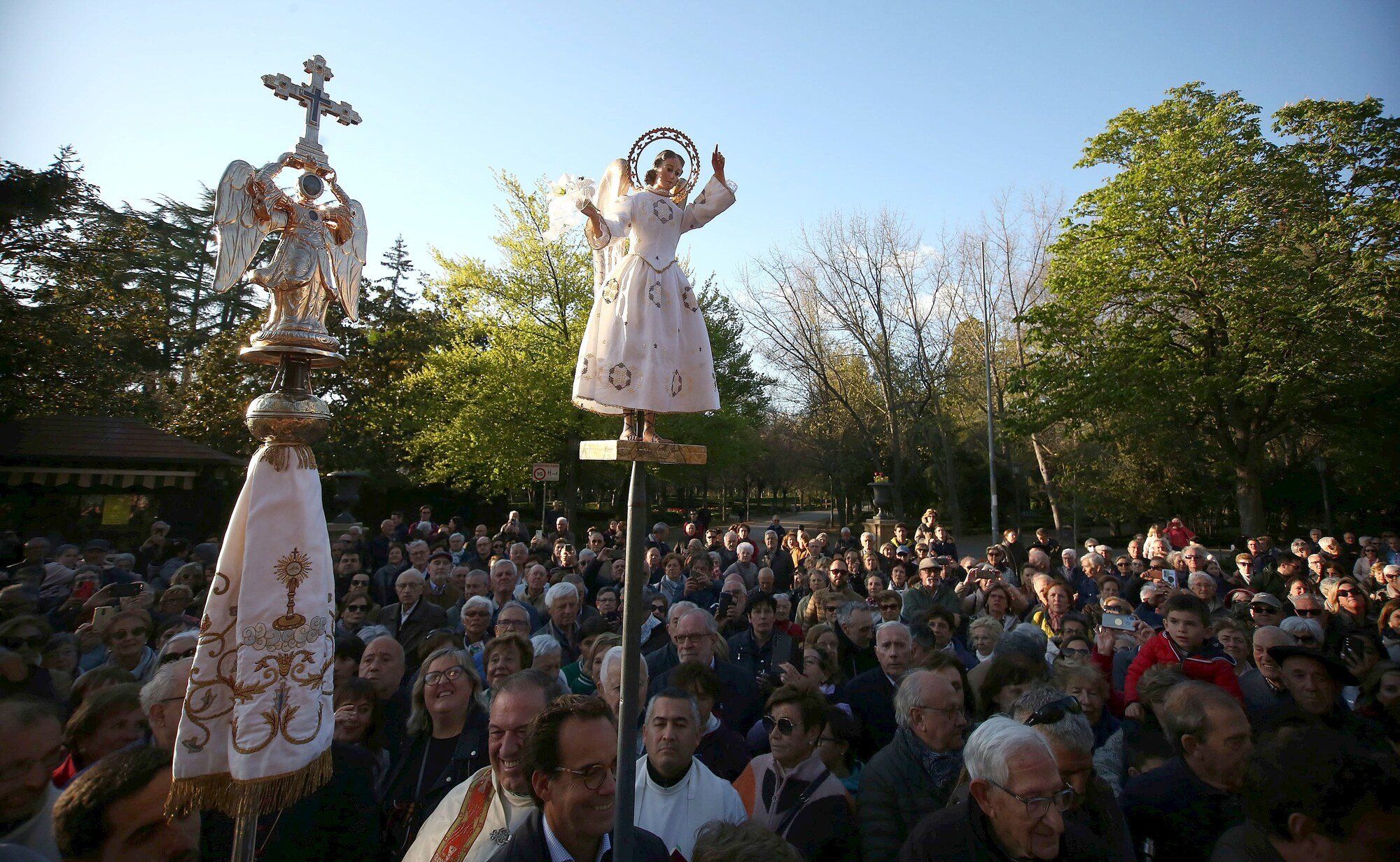
The Brotherhood was founded in time immemorial. Its responsibility was to establish, in each village visited by the effigy of Saint Miguel during its annual tours, a house whose owner or administrator received the title of Brother of the Sanctuary. That person undertook to receive, accommodate, and provide for the chaplains and others who carried the image; safeguard the Holy Image overnight; and accept, for safekeeping, offerings intended for the Sanctuary. In return, whenever a Brother visited the Sanctuary of Aralar, they were provided with free accommodation.
In each village, the Brotherhood was associated with a specific house, and its successive owners automatically continued to perform the duties of lodging the priest and the bearers of the image, safeguarding it, and representing all the Brotherhood members in the locality.
In 1916, when the Brotherhood was reconstituted, new statutes for the Holy Brotherhood were also approved. They stipulated that each village could have no more than one Brother, and that a Brotherhood would be established only in places visited by the Holy Angel or where collections were held in support of the Sanctuary.


