Skip links

History

Chronology, building, effigy, altarpiece, legend, authors, and practical information:
Tourist office, tourist attractions, tourist services (update the links, preferably elsewhere).

Chronology

Below, we present the historical chronology of Saint Miguel of Aralar. To view the chronology of the building’s construction, click this link.

Saint Miguel of Aralar
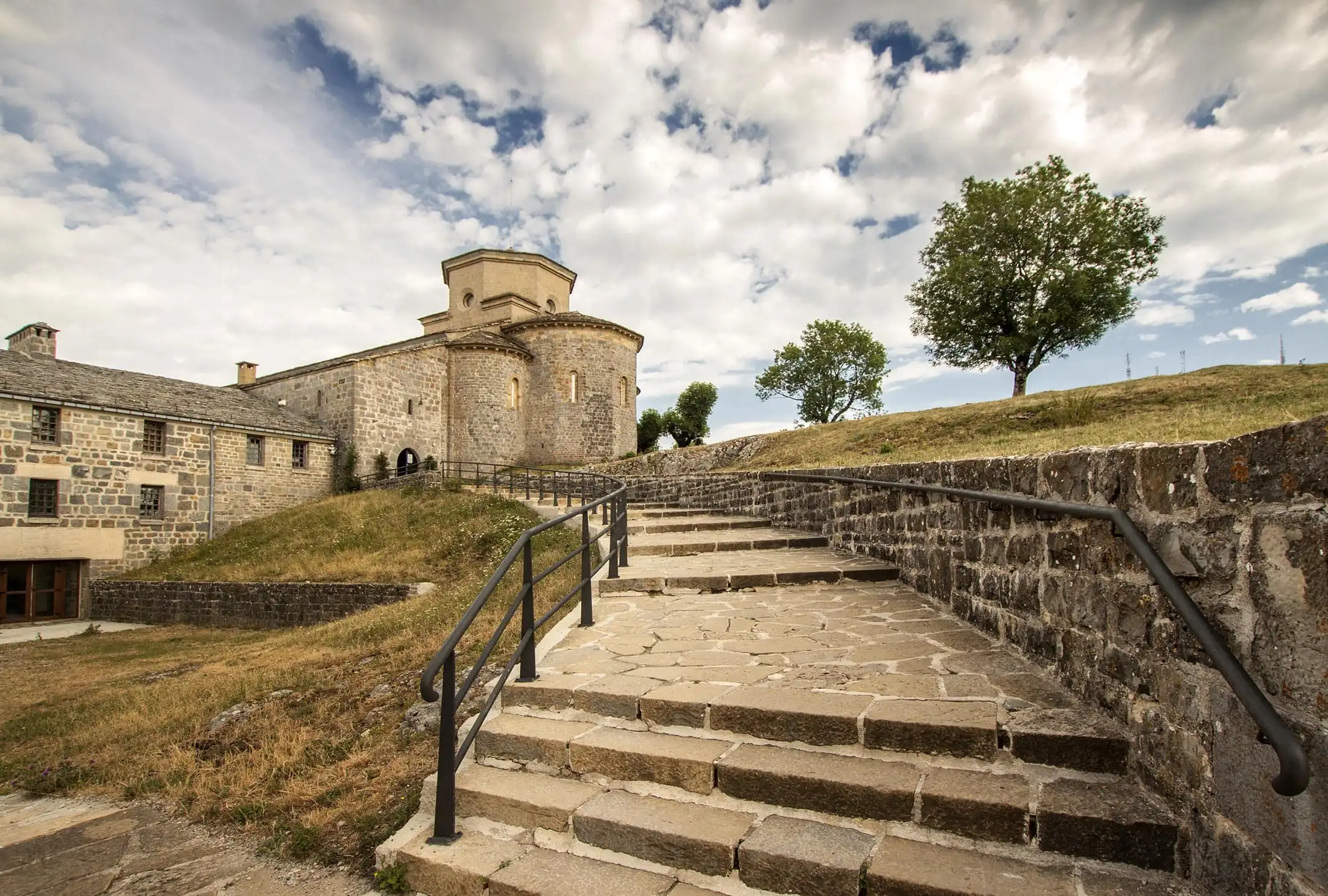
  • 1032. King Sancho Garcés of Navarre, Sancho III the Great, granted a privilege concerning the restoration of the Diocese of Pamplona. In this document, the Sanctuary of Aralar is mentioned for the first time in written records as a church dependent on Santa María de Zamarce, one of the stops on the old pilgrimage route to Santiago that crossed the Barranca region. The original sanctuary—a Carolingian church—appears to date from the ninth century and may have been destroyed in an Arab raid, perhaps in 924.
  • 1040. King García Sánchez of Nájera of Navarra and his wife, Estefanía, made a donation to the Sanctuary, dedicated “to the worship of Saint Mary Ever Virgin and of the holy men and women, apostles, martyrs, confessors, and virgins whose relics were kept there.” They donated the monastery of Aguinarte and the villages of Muztillano and Berroeta. King Sancho Ramírez (1076–1094) confirmed the earlier donations and granted the Sanctuary a monastery in Araquil called Allazozábal.
  • 1074. This date is regarded by several authors as the date of the consecration of the new Romanesque church, consisting of the present-day chancel and built with three naves. King Sancho IV of Peñalén, who had previously donated fifteen mountain pastures in the Aralar mountains and elsewhere, confirmed on this date all the Sanctuary’s properties, while it was still dependent on Zamarce, “on the day of its consecration.” Don Ramiro, a royal prince of Navarra, the second son of García of Nájera and brother of Sancho of Peñalén, fought in the Holy Land and took part in the conquest of Jerusalem in 1099. He brought back to Navarra an arm of the Cross of Christ. He personally visited Aralar and left there a fragment of the Lignum Crucis, as well as donations in vicariates, revenues, and tithes. For several centuries, the cross was kept in the tabernacle, adorned with silver and enclosed in an ivory box; in 1756, it was incorporated into the effigy of Saint Miguel.
  • 1087. King Sancho Ramírez and his son, Pedro Sánchez, acknowledged various possessions belonging to the Bishop of Pamplona, including the monastery of Zamarce, with its Church of Saint Miguel del Monte Excelso, and the villages of Saint Miguel of Excelsis. At the end of the eleventh century, during the reign of Sancho Ramírez and while Pedro de Roda was Bishop of Pamplona, the knight García de Arnalt de Goñi left his home and devoted himself to the worship of Saint Miguel as a hermit. Using the alms he received, he built the church, according to the "Libro de los Milagros"(Book of Miracles).
  • 1098. A date regarded by some authors as that of the church’s consecration, a ceremony attended by seven bishops. Tomás de Burgui suggests that they may have been the bishops from the territories of King Pedro Sánchez: Pamplona, Jaca, Bordeaux, Calahorra, Nájera, Huesca, and Santiago, or perhaps Marseille and Arles. The ceremony is thought to have taken place in early September, since the feast of the dedication was celebrated, until recently, on the first Sunday of that month.
  • 1099. Pedro Sánchez, King of Navarra and Aragon, showed his generosity toward the Sanctuary after his miraculous recovery. In his Compendium, Esteban de Garibay y Zamalloa states that he “climbed this mountain range on foot, carrying saddlebags loaded with sand for the construction of the Sanctuary, after he was miraculously cured one night in this church of an illness considered incurable by nature, having experienced the aid of the heavenly prince.” In February 1099, he donated the place of Murguinto to God and Saint Miguel; in 1103, he donated the village of Arguindoain (Arakil) and two monasteries within its territory: Santo Thomás de Mendibezua and Izaga.
  • 1125. Alfonso the Battler exempted Saint Miguel’s dependent tenants from royal obligations, so that they would serve only the Sanctuary.
  • 1130. Alonso Sánchez the Battler, King of Navarre, donated to the Sanctuary estates in Tudela and near Moncayo, extending from Gallur to Cadreita.
  • 1141. Possible year of the church’s consecration in its present layout: three three-bay aisles and a narthex. García Ramírez, King of Navarre, made donations to the Sanctuary “in favour of Saint Miguel, at the dedication of this church.” From this date onward, a monastic community was established.
  • 1167. The building attached to the south side of the Sanctuary was constructed; it would later become the headquarters of the Brotherhood of Saint Miguel.
  • 1175. Around this year, the enamelled altarpiece, or frontal, was made. It appears to have been commissioned by King Sancho VI the Wise and Bishop Pedro de París to enhance the distinction of the Sanctuary. Its creators were likely a team of goldsmiths and enamellers from Limoges who carried out their work in Navarre.
  • 1229. Pedro Ramírez de Piérola, Bishop of Pamplona, approved the statutes of the Brotherhood of Saint Miguel. He donated his house, adjoining the church, to the Brotherhood on the condition that the Bishop of Pamplona would serve as its head and rector.
  • 1368. In an edict, Bishop Bernardo Folcaut noted that the Brotherhood of Saint Miguel had a very large membership: as many as 40,000 members, served by 20 clerics.
Effigy and altarpiece of Saint Miguel of Aralar
  • 1620. Attempted robbery at the Sanctuary. Three thieves who entered to steal were left unable to move inside the church and were apprehended.
  • 1687. The image was stolen by Manuel González and Juan de Jáuregui. One was hanged, and the other was sentenced to life imprisonment.
  • 1756. The wooden effigy of Saint Miguel was placed in the gilded-silver reliquary in which it is known today. The fragment of the Lignum Crucis held by the Sanctuary since the late 11th century was placed at its top.
  • 1765. The enamelled altarpiece of Aralar, which had served as the altar frontal of the inner chapel since its creation in the late 12th century, was moved to Pamplona for cleaning and restoration. It was then installed on the Sanctuary’s main altar.
  • 1797. Robbery at the Sanctuary committed by seven French Basque charcoal burners. They bound the servants and stole everything they could, including the effigy of Saint Miguel, which they broke into three pieces. They were captured, and three of them were executed by hanging in Pamplona.
  • 1799. The Cathedral Music Chapel performed at the Sanctuary on the Day of the Brotherhoods, a traditional gathering held in August on the Sunday following the Assumption, 15 August.
  • 1865. Pedro de Madrazo y Kuntz, an expert in artistic antiquities, visited the Sanctuary and admired its enamelled altarpiece. He described it in two publications and brought this treasure to the attention of artistic and historical circles. From then on, it began to be recognised as a masterpiece of medieval goldsmithing.
  • 1884. King Alfonso XII of Spain, who was taking the waters at the Betelu spa, travelled from Lekunberri to the Sanctuary on 2 August, riding a mount provided by Vicente Astiz, a resident of Lekunberri. He was accompanied by the Minister of War, General Quesada; his aide, the Duke of Sexto; and his personal physician, Dr Camisón.
  • 1889. A major pilgrimage organised by the Diocese of Pamplona, comprising more than 15,000 faithful from the capital and other towns, arrived at the Sanctuary on 3 June to commemorate the 13th centenary of Spain’s Catholic unity (the conversion of Reccared in 589).
  • 1899. On 25 August, a second major pilgrimage was held at the Sanctuary of Aralar to mark the end of the 19th century. Nearly 20,000 people gathered there, along with 47 parish crosses from the nearby valleys of La Barranca, Larraun and Araiz.
  • 1902. On 18 August, King Alfonso XIII of Spain visited the Sanctuary. He walked up from Uharte Arakil.
  • 1909. In September, the writer and thinker Miguel de Unamuno travelled up to the Sanctuary. He recounted the experience in an article included in his work “Por tierras de Portugal y de España”(Through the Lands of Portugal and Spain).
  • 1925. Electricity reached the Sanctuary of Aralar through a generator, later secured by the installation of a permanent power line. A second telephone was also installed at the Sanctuary that year.
  • 1931. On 4 June, the Sanctuary of Aralar was declared a Historic-Artistic Monument forming part of Spain’s National Artistic Treasure, by decree of the Ministry of Public Instruction and Fine Arts of the Spanish Republic.
  • 1936. The first automobile reached the Sanctuary. On 12 January, a tracked vehicle bearing registration SS 7945 overcame the lack of a road and travelled the entire route to reach the Sanctuary.
  • 1942. A devastating fire completely destroyed the Sanctuary’s guesthouse. The prompt action of the Sanctuary’s residents and of people from Uharte Arakil and other nearby villages prevented the fire from reaching the church.
  • 1942–1972. The Deierri House, or Lakuntzetxe, was used to serve the Sanctuary while the new guesthouse was being built.
  • 1965. In September, the access road to the Sanctuary from the Forestry House, in the Bustingorrieta area, was inaugurated. The road from Baraibar, in the Larraun Valley, to that point had been built in 1949.
  • 1966. The Provincial Council of Navarre agreed to build a new guesthouse for the Sanctuary, including accommodation areas, a bar and an open shelter.
    The project was entrusted to architect José Luis Cía, assisted by Julián Arteaga. Construction began in 1968 and was completed in September 1972.
  • 1972. The Príncipe de Viana Institution of the Provincial Council of Navarre, under the direction of Francisco Iñiguez Almech, undertook a comprehensive restoration of the monument, including the reconstruction of its octagonal lantern tower.
  • 1979. A gang of thieves led by the international criminal “Erik the Belgian” tore off and stole every piece of the enamelled altarpiece.
  • 1981. After Interpol circulated a dossier detailing the identifying features of the Aralar enamels, they were recovered in various locations: Paris, Rome and Ghent.
  • 1982. The road directly linking Uharte Arakil and the Sanctuary was opened.
  • 1991. On 20 May, the enamelled frontal of Aralar was reinstalled at the Sanctuary, with appropriate security measures in place.
  • 1996. On 30 December, the Government of Navarre, by Regional Decree, designated the Romanesque enamelled frontal of the Sanctuary of Saint Miguel of Aralar as an Asset of Cultural Interest, recognising it as one of the most important works of medieval European enamelling.
  • 1997. The Government of Navarre carried out the monument’s most recent restoration, renewing the roof, clearing debris from the roof space and installing underfloor heating. The work lasted ten months and was directed by architect Javier Sancho.
  • 2001. Don Inocencio Ayerbe, chaplain of the Sanctuary since 1945, died.
  • 2002. Renovation work began on the guesthouse to convert it into a restaurant and café.
Santuario de San Miguel de Aralar

The Building

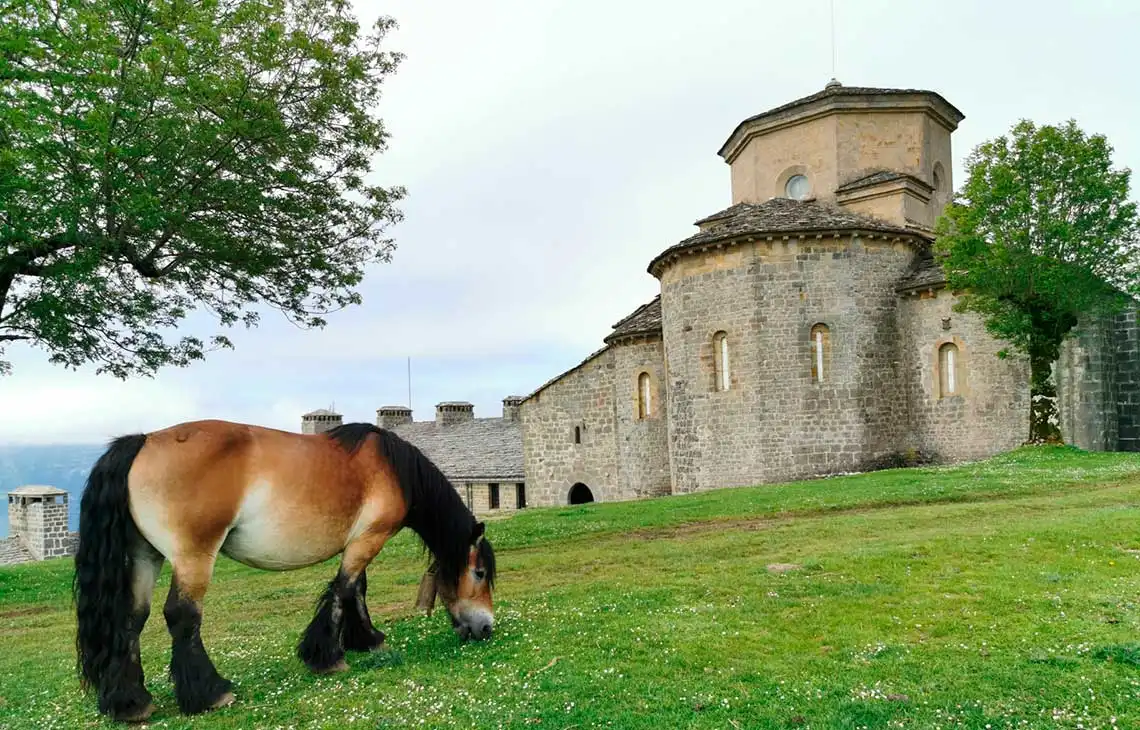
The Sanctuary that visitors can see today at the summit of Aralar is a Romanesque complex that largely retains the appearance it had in the 12th century. However, studies carried out in the 1970s suggest that an earlier 9th-century church once stood on the site. It may have been almost entirely destroyed during a Muslim advance, although some sections of its walls were reportedly reused in the new church. The Romanesque church was probably built in two phases, during the 11th and 12th centuries. The first phase comprised the apse area, while the second expanded the complex with the three naves and the narthex.

Chronology of the Construction

  • 9th century. Possible Carolingian church, which may have been destroyed by Abd al-Rahman III in 924.
  • 1032. First document referring to the Sanctuary: a privilege granted by Sancho the Great.
  • 1074. The church, comprising the area occupied by the present-day apses, was consecrated.
  • 1141. García Ramírez the Restorer donated the dependent tenants of Berástegui on the feast of the church’s dedication.
  • First half of the 12th century. The present building, including its narthex or enclosed cloister, was constructed. It was consecrated in 1141.
  • 1175. Construction of the inner chapel, possibly coinciding with the gift of the enamelled frontal.
  • 1939. Restoration work.
  • 1967–1977. Excavation and restoration work directed by Francisco Iñiguez.
  • 1997. The most recent restoration of the roof and roof spaces, along with the installation of underfloor heating, was carried out by the Príncipe de Viana Institution of the Government of Navarre under the direction of Javier Sancho.
  • 2020. Restoration of the Lakuntzetxe, or Deierri, house, which originated as the Brotherhood House built in 1191 by order of Bishop Pedro de Artajona. The Sanctuary also initiated repairs to the narthex roof.

The effigy

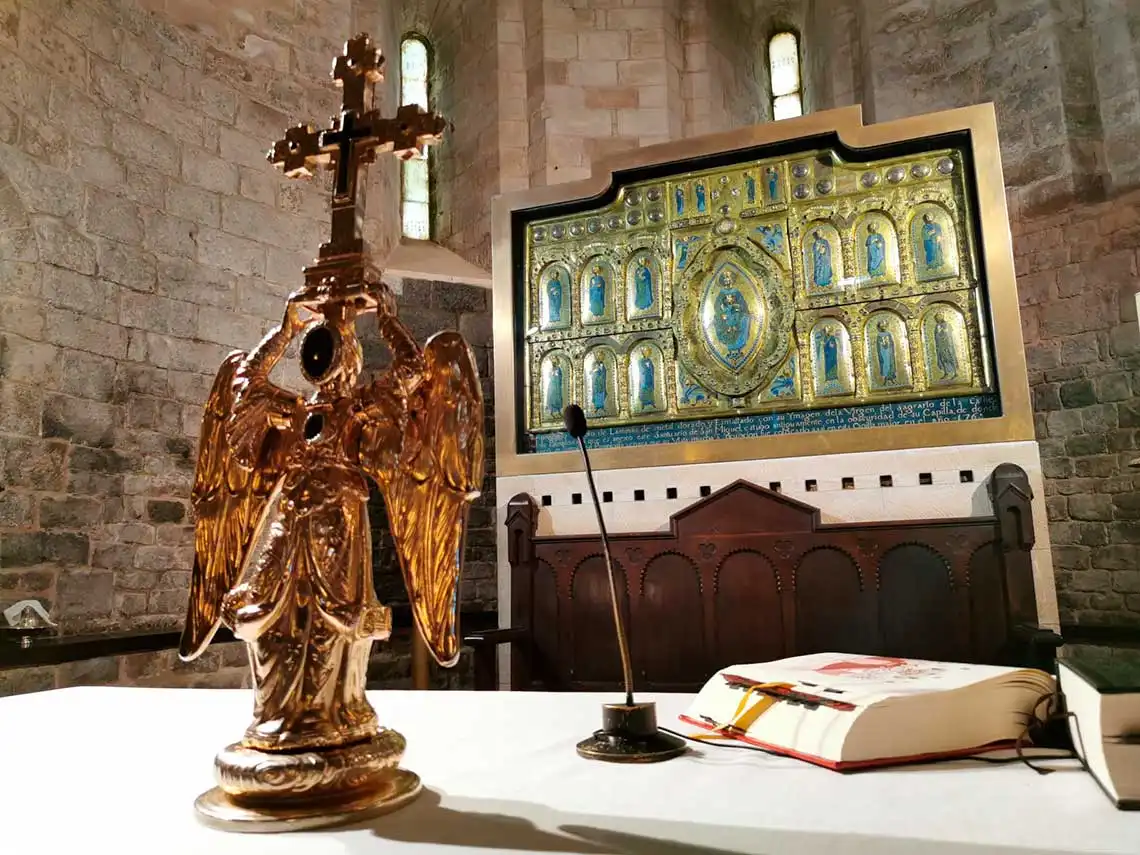
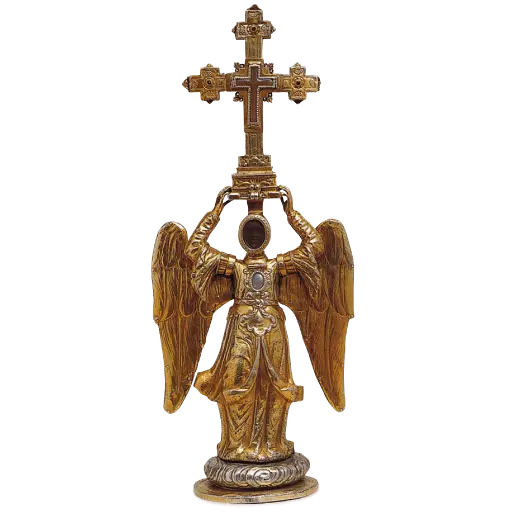
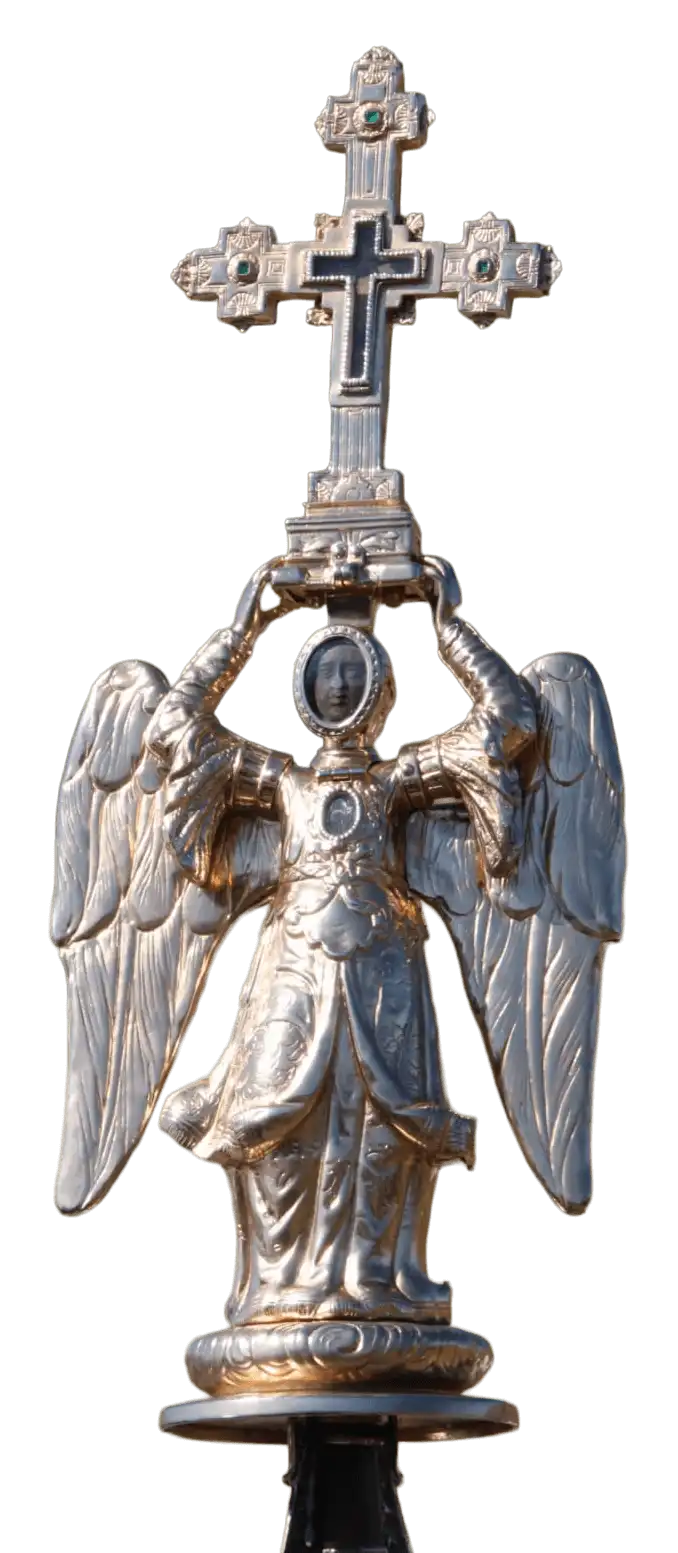
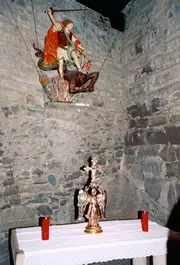
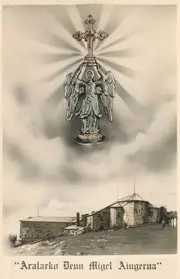
On 23 April 1756, by order of Dr Juan Lorenzo de Irigoyen, and in the presence of witnesses, the image’s silver covering was replaced. New wooden wings, arms and a cross, believed to have been missing from the original image, were also fitted. At the same time, a cross set in tin was installed, containing fragments of the Lignum Crucis that had until then been kept in an ivory casket in the tabernacle of the Chapel of Saint Miguel. In 2017, the damaged silver on the angel’s body and wings was restored. This work also allowed for an in-depth examination of the wooden core of the present image, in order to trace how the effigy had appeared throughout its history.

Effigy of Saint Miguel of AralarThroughout the centuries, the image has been stolen on several occasions: one such attempt took place in 1620, when Don Miguel de Leiza was abbot of the Sanctuary, but the theft was thwarted when the thieves were miraculously immobilized; another occurred in 1687, when Manuel González and Juan de Jáuregui took the image and threw its head—which was not covered in silver—a short distance from the Sanctuary. A third theft of the image took place in 1797. On April 23, 1756, on the orders of Dr. Juan Lorenzo de Irigoyen, the image’s gilded-silver covering was replaced in the presence of witnesses. The wings, arms, and cross—believed to have been missing from the original image—were also replaced with new wooden ones. At the same time, a silver-set cross containing the Lignum Crucis from the chapel’s high altar was placed on Saint Michael’s cross.

Saint Miguel is the warrior archangel, captain of the heavenly armies, and prince of the battle against the rebellious angels. He is mentioned in the Bible, in several books of the Old Testament and in Revelation, where he saves the woman who has just given birth, symbolizing the Virgin Mary and the Church, and battles the seven-headed dragon, the ultimate embodiment of evil, whom he defeats.

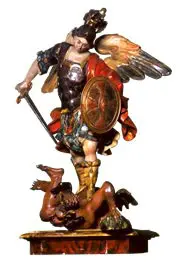
The most widespread representation of Saint Miguel, dating from the medieval period and the early Renaissance, depicts him dressed as a warrior, wearing armor and carrying a shield, standing above a dragon—representing the devil—whom he strikes with his lance. The image of a man standing over a monster that he has subdued beneath his feet was already known in antiquity, in civilizations such as Egypt and Rome, and later in the Muslim world. In Egypt, it was Horus who slew the crocodiles of the Nile and other harmful animals; in Roman art, the emperor Constantine appears triumphantly battling a dragon; and in Islam, it is Khidr, the Muslim hero who defeats the monster.
Iconography of Saint MiguelIt is also common for him to appear in his role as a psychopomp, that is, weighing souls and presenting them before God at the Judgment.
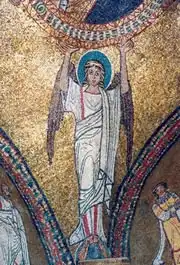
However, the titular effigy of the Sanctuary of Aralar presents a much more original and theologically significant image: the Archangel holding Christ’s cross aloft above his head. This image was already depicted in the tenth century in an admirable pre-Romanesque relief from the Church of Saint Miguel in Villatuerta, now preserved in the Museum of Navarra, and two centuries later on the portal of the Romanesque church of Berrioplano (twelfth century). It is also connected with Early Christian effigies that can be seen in magnificent mosaics on two vaults in Ravenna and Rome. The first is located in the Archiepiscopal Chapel of Saint Andrew in Ravenna, where four angels emerging from the four corners hold a chrismon, the symbolic monogram of Christ, above their heads. In Rome, the vault of the Chapel of San Zeno in the Church of Santa Prassede, very close to Saint Mary Major, depicts a similar scene in which four angels with raised arms support a bust of Christ surrounded by a circular halo.

The image of Aralar, like the others mentioned, goes beyond the more numerous depictions of the warrior conquering evil, represented by the dragon, in its theological meaning. It shows us that Saint Miguel conquers evil through the Cross of Christ, who dies upon it to save humanity. Thus, Christ is presented to us as the true conqueror of evil, while the angel Miguel is the herald of that good news.
Iconography of Saint MiguelThe Archangel Saint Miguel was the protector of the Kingdom of Navarra. On numerous occasions, the kings and institutions of Navarra sought his intercession. This devotion to the captain of the heavenly armies was one of the most deeply rooted and widespread in the Christian world during the Middle Ages.

The widespread devotion to Saint Miguel in Navarre is evidenced by the very large number of parishes, monasteries, hermitages, altarpieces, and images dedicated to his worship, amounting to more than 320 direct references.
Parishes

Iconography of Saint MiguelNavarre has 56 parishes dedicated to the Archangel Saint Miguel throughout its territory, as well as two basilicas and the Sanctuary of Saint Miguel in Excelsis on Mount Aralar. In another 20 parishes or churches, there is an altarpiece dedicated to Saint Miguel, while a further 140 churches venerate an image of the holy archangel.

The parishes or basilicas dedicated to Saint Miguel are located in the following towns:
Aoiz, Arraiza, Arribe, Artazu, Badostáin, Baraibar, Barbatáin, Barillas, Beramendi, Beunza, Cábrega, Cadreita, Cárcar, Cía (Iza), Ciriza, Corella, Ecala, Eraul, Eguillor, Egozcue, Eraso, Erice, Eslava, Estella, Etxarri (Larraun), Idoy, Igantzi, Ilarregui, Iturmendi, Larraga, Larráin (Adiós), Leitza, Lizoain, Lodosa, Marcaláin, Mendivil, Metauten, Noain, Olaiz (Olaibar), Olaldea (Oroz Betelu), Olazagutia, Olcoz, Orcoyen, Oteiza, Pamplona, Sarría (Puente la Reina), Sagüés, Salinas de Ibargoiti, Salinas de Oro, Udabe, Uitzi, Urdániz, Urroz, Uterga, Zarranz, and Zufía. Arguedas and Peralta have basilicas dedicated to Saint Miguel.

In addition to those mentioned above, 20 parishes or churches are documented as having an altarpiece dedicated to Saint Miguel. In a further 140 churches in Navarre, there are effigies of the Archangel Saint Miguel.

Hermitages

In his book "Ermitas de Navarra"(Hermitages of Navarre), Fernando Pérez Ollo cites references to a total of 110 hermitages, besides the Sanctuary of Aralar, dedicated to Saint Miguel in Navarre throughout history. Some are still in use, while others are no longer used for worship or have fallen into ruin; in some cases, only their memory survives in the place name where they once stood.

The following 45 localities have a hermitage dedicated to Saint Miguel:
Iconography of Saint MiguelAbáigar, Abárzuza, Abaurrea Alta, Ablitas, Ainzoain, Alzuza, Alloz, Ansoáin, Aranarache, Arguedas, Aristu, Arizaleta, Arizkun, Arruitz, Artozqui, Arzoz, Atondo, Barásoain, Barbatáin, Beunza, Echávarri (Allín), Elía (Amocáin), Esténoz, Galdeano, Gastiáin (Iriberrigutxia), Goñi, Idoate (shared with Lerruz), Irañeta, Iroz, Izal, Lerruz (shared with Idoate), Lizarraga (Ergoyena), Mezkiriz, Olaz (Galar), Rocaforte, San Martín de Unx, Santesteban, Ucar, Ujué, Uli (Lónguida), Urdániz, Vidángoz, Villatuerta, Zabalza (Urraul), Zuazu (Izaga), and Zuza. This list may be supplemented by the original tower of Javier Castle, dedicated to the Archangel Saint Miguel, although it is not technically a hermitage.

The memory of a further 64 former hermitages dedicated to Saint Miguel has been preserved through historical documentation, images now kept in other churches, or place names in other localities, extending from Valcarlos to Tudela and from Acedo to Petilla de Aragón.

Related links

The presbytery of the Sanctuary of Aralar is dominated by the enamel altarpiece of Saint Mary, a unique treasure of medieval European enamelling. In addition to the altarpiece, we consider the legend of Teodosio de Goñi and other information linked through these banners to be of interest:

The altarpiece

The altarpiece

información
The legend

The legend

información
This site is registered on wpml.org as a development site. Switch to a production site key to remove this banner.