 Throughout the centuries, the image has been stolen on several occasions: one such attempt took place in 1620, when Don Miguel of Leiza was abbot of the Sanctuary, but the theft was thwarted when the thieves were miraculously immobilized; another occurred in 1687, when Manuel González and Juan de Jáuregui took the image and threw its head—which was not covered in silver—a short distance from the Sanctuary. A third theft of the image took place in 1797.
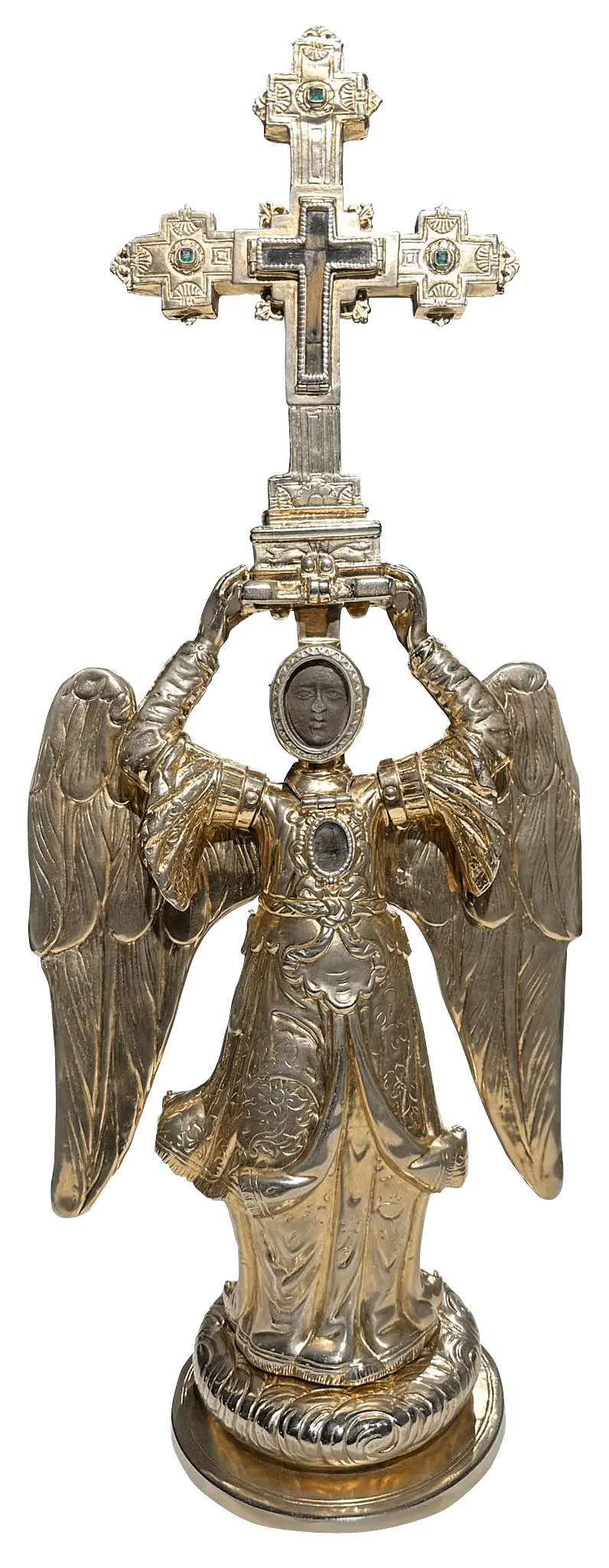
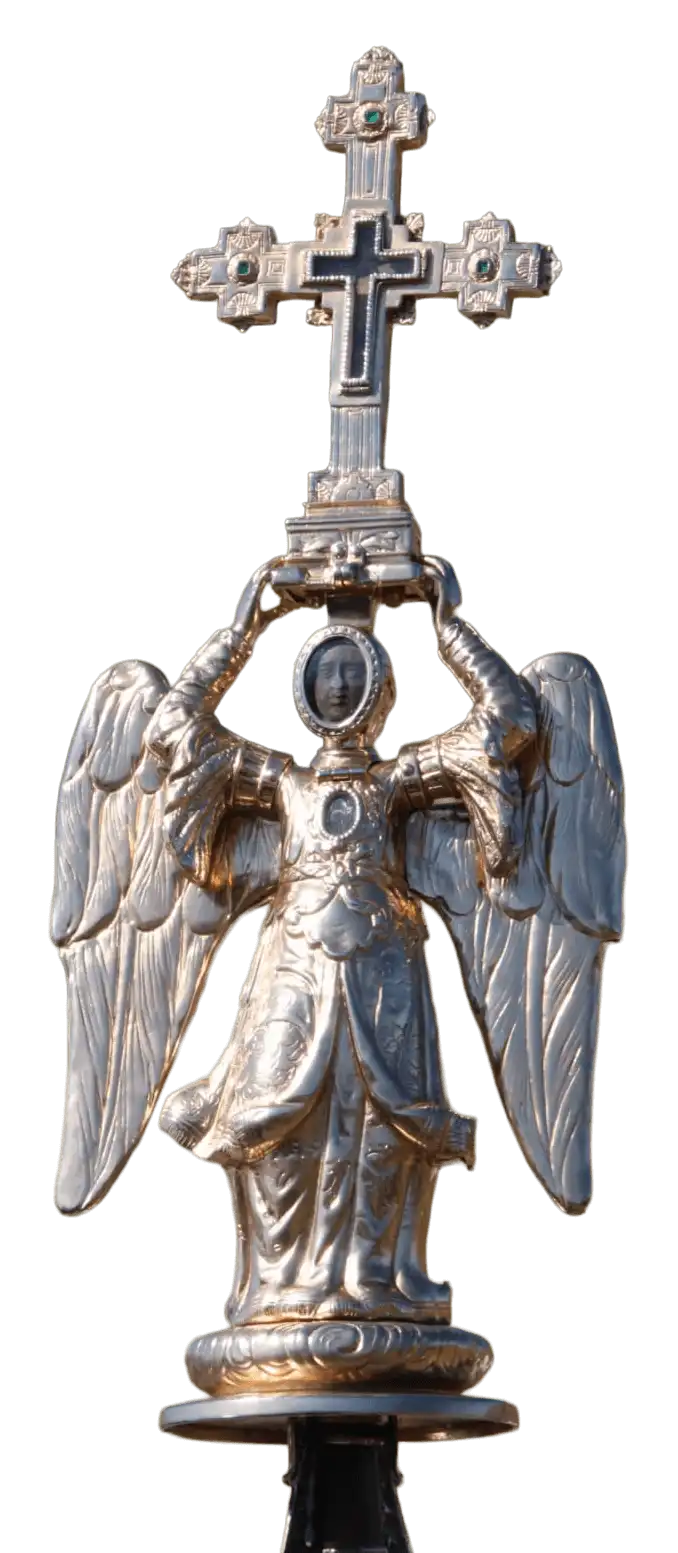
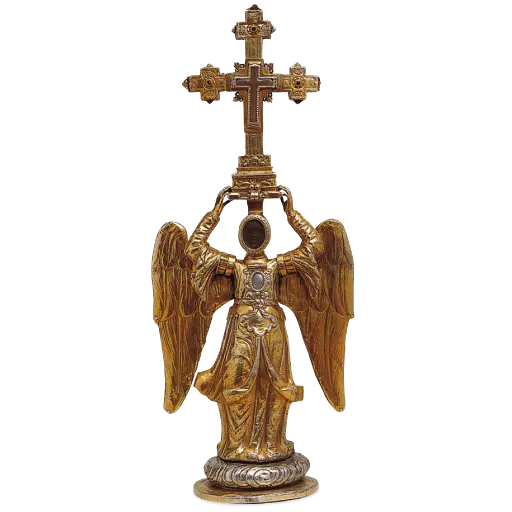
On April 23, 1756, on the orders of Dr. Juan Lorenzo de Irigoyen, the image’s gilded-silver covering was replaced in the presence of witnesses. The wings, arms, and cross—believed to have been missing from the original image—were also replaced with new wooden ones. At the same time, a silver-set cross containing the Lignum Crucis from the chapel’s high altar was placed on Saint Miguel’s cross.
Throughout the centuries, the image has been stolen on several occasions: one such attempt took place in 1620, when Don Miguel of Leiza was abbot of the Sanctuary, but the theft was thwarted when the thieves were miraculously immobilized; another occurred in 1687, when Manuel González and Juan de Jáuregui took the image and threw its head—which was not covered in silver—a short distance from the Sanctuary. A third theft of the image took place in 1797.
On April 23, 1756, on the orders of Dr. Juan Lorenzo de Irigoyen, the image’s gilded-silver covering was replaced in the presence of witnesses. The wings, arms, and cross—believed to have been missing from the original image—were also replaced with new wooden ones. At the same time, a silver-set cross containing the Lignum Crucis from the chapel’s high altar was placed on Saint Miguel’s cross. Saint Miguel is the warrior archangel, captain of the heavenly armies, and prince of the battle against the rebellious angels. He is mentioned in the Bible, in several books of the Old Testament and in Revelation, where he saves the woman who has just given birth, symbolizing the Virgin Mary and the Church, and battles the seven-headed dragon, the ultimate embodiment of evil, whom he defeats.
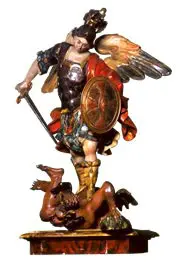
The most widespread representation of Saint Miguel, dating from the medieval period and the early Renaissance, depicts him dressed as a warrior, wearing armor and carrying a shield, standing above a dragon—representing the devil—whom he strikes with his lance. The image of a man standing over a monster that he has subdued beneath his feet was already known in antiquity, in civilizations such as Egypt and Rome, and later in the Muslim world. In Egypt, it was Horus who slew the crocodiles of the Nile and other harmful animals; in Roman art, the emperor Constantine appears triumphantly battling a dragon; and in Islam, it is Khidr, the Muslim hero who defeats the monster.
 It is also common for him to appear in his role as a psychopomp, that is, weighing souls and presenting them before God at the Judgment.
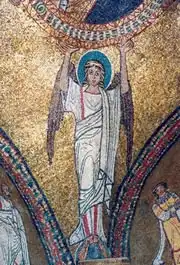
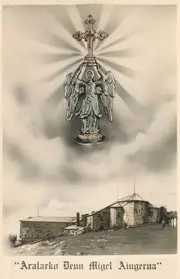
However, the titular effigy of the Sanctuary of Aralar presents a much more original and theologically significant image: the Archangel holding Christ’s cross aloft above his head. This image was already depicted in the tenth century in an admirable pre-Romanesque relief from the Church of Saint Miguel in Villatuerta, now preserved in the Museum of Navarra, and two centuries later on the portal of the Romanesque church of Berrioplano (twelfth century). It is also connected with Early Christian effigies that can be seen in magnificent mosaics on two vaults in Ravenna and Rome. The first is located in the Archiepiscopal Chapel of Saint Andrew in Ravenna, where four angels emerging from the four corners hold a chrismon, the symbolic monogram of Christ, above their heads. In Rome, the vault of the Chapel of San Zeno in the Church of Santa Prassede, very close to Saint Mary Major, depicts a similar scene in which four angels with raised arms support a bust of Christ surrounded by a circular halo.
The image of Aralar, like the others mentioned, goes beyond the more numerous depictions of the warrior conquering evil, represented by the dragon, in its theological meaning. It shows us that Saint Miguel conquers evil through the Cross of Christ, who dies upon it to save humanity. Thus, Christ is presented to us as the true conqueror of evil, while the angel Miguel is the herald of that good news.
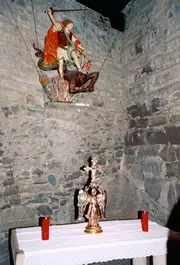
 The Archangel Saint Miguel was the protector of the Kingdom of Navarra. On numerous occasions, the kings and institutions of Navarra sought his intercession. This devotion to the captain of the heavenly armies was one of the most deeply rooted and widespread in the Christian world during the Middle Ages.
The widespread devotion to Saint Miguel in Navarra is evidenced by the very large number of parishes, monasteries, hermitages, altarpieces, and images dedicated to his worship, amounting to more than 320 direct references.
 Navarre has 56 parishes dedicated to the Archangel Saint Miguel throughout its territory, as well as two basilicas and the Sanctuary of Saint Miguel in Excelsis on Mount Aralar. In another 20 parishes or churches, there is an altarpiece dedicated to Saint Miguel, while a further 140 churches venerate an image of the holy archangel.
The parishes or basilicas dedicated to Saint Miguel are located in the following towns:
Aoiz, Arraiza, Arribe, Artazu, Badostáin, Baraibar, Barbatáin, Barillas, Beramendi, Beunza, Cábrega, Cadreita, Cárcar, Cía (Iza), Ciriza, Corella, Ecala, Eraul, Eguillor, Egozcue, Eraso, Erice, Eslava, Estella, Etxarri (Larraun), Idoy, Igantzi, Ilarregui, Iturmendi, Larraga, Larráin (Adiós), Leitza, Lizoain, Lodosa, Marcaláin, Mendivil, Metauten, Noain, Olaiz (Olaibar), Olaldea (Oroz Betelu), Olazagutia, Olcoz, Orcoyen, Oteiza, Pamplona, Sarría (Puente la Reina), Sagüés, Salinas de Ibargoiti, Salinas de Oro, Udabe, Uitzi, Urdániz, Urroz, Uterga, Zarranz, and Zufía. Arguedas and Peralta have basilicas dedicated to Saint Miguel.
In addition to those mentioned above, 20 parishes or churches are documented as having an altarpiece dedicated to Saint Miguel. In a further 140 churches in Navarre, there are effigies of the Archangel Saint Miguel.
In his book "Ermitas de Navarra"(Hermitages of Navarre), Fernando Pérez Ollo cites references to a total of 110 hermitages, besides the Sanctuary of Aralar, dedicated to Saint Miguel in Navarre throughout history. Some are still in use, while others are no longer used for worship or have fallen into ruin; in some cases, only their memory survives in the place name where they once stood.
The following 45 localities have a hermitage dedicated to Saint Miguel:
 Abáigar, Abárzuza, Abaurrea Alta, Ablitas, Ainzoain, Alzuza, Alloz, Ansoáin, Aranarache, Arguedas, Aristu, Arizaleta, Arizkun, Arruitz, Artozqui, Arzoz, Atondo, Barásoain, Barbatáin, Beunza, Echávarri (Allín), Elía (Amocáin), Esténoz, Galdeano, Gastiáin (Iriberrigutxia), Goñi, Idoate (shared with Lerruz), Irañeta, Iroz, Izal, Lerruz (shared with Idoate), Lizarraga (Ergoyena), Mezkiriz, Olaz (Galar), Rocaforte, San Martín de Unx, Santesteban, Ucar, Ujué, Uli (Lónguida), Urdániz, Vidángoz, Villatuerta, Zabalza (Urraul), Zuazu (Izaga), and Zuza. This list may be supplemented by the original tower of Javier Castle, dedicated to the Archangel Saint Miguel, although it is not technically a hermitage.
The memory of a further 64 former hermitages dedicated to Saint Miguel has been preserved through historical documentation, images now kept in other churches, or place names in other localities, extending from Valcarlos to Tudela and from Acedo to Petilla de Aragón.


