

Over time, different hypotheses have been put forward concerning the date on which the enamel altar frontal of Saint Miguel of Aralar was made. Some authors(Burgui and Marcotegui) were guided by the inscription on the scroll, or phylactery, held by an angel, in which they believed they could read the date 1028. They therefore proposed that year as its date of creation and attributed its donation to Sancho Garcés III “the Great,” King of Navarre at the time.
Others considered it earlier: Arigita dated it to the 6th century. Still others placed it later, at different points during the 12th and 13th centuries, including Huici and Juaristi, Gómez Moreno, Lojendio, and Uranga and Íñiguez.
More recently, following a detailed study carried out in 1982, Marie Madeleine Gauthier, a research professor at France’s National Centre for Scientific Research, provided what appear to be the most plausible findings, dating its creation to the beginning of the final quarter of the 12th century. Today, medieval goldsmithing specialist Lourdes de San José Llongueras is investigating the details of this treasure’s connection with the masters of Limoges and concurs with Mme Gauthier.
“The artistic configuration of the features that characterize this work of southern enamelling, renowned among the ten thousand examples now catalogued and classified,” Gauthier writes, “makes it possible to date its production between 1175 and 1185.” At that time, Sancho VI “the Wise” reigned in Navarre, while Pedro de Artajona, better known as Pedro de París, held the episcopal see. It may be thought that both were directly involved in the creation of this singular work of art, during a period of cultural and artistic flourishing in the kingdom. The Romanesque Cathedral of Pamplona was still being embellished, monasteries such as La Oliva, Iratxe and Irantzu were beginning their development, and towns such as Estella were flourishing.
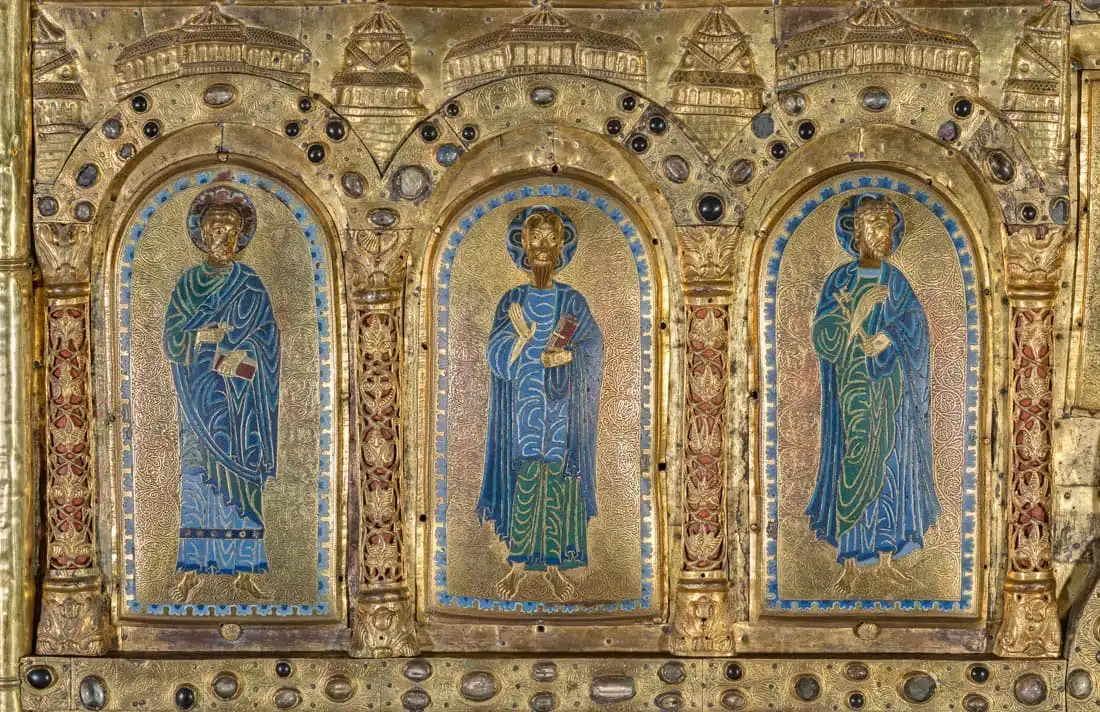
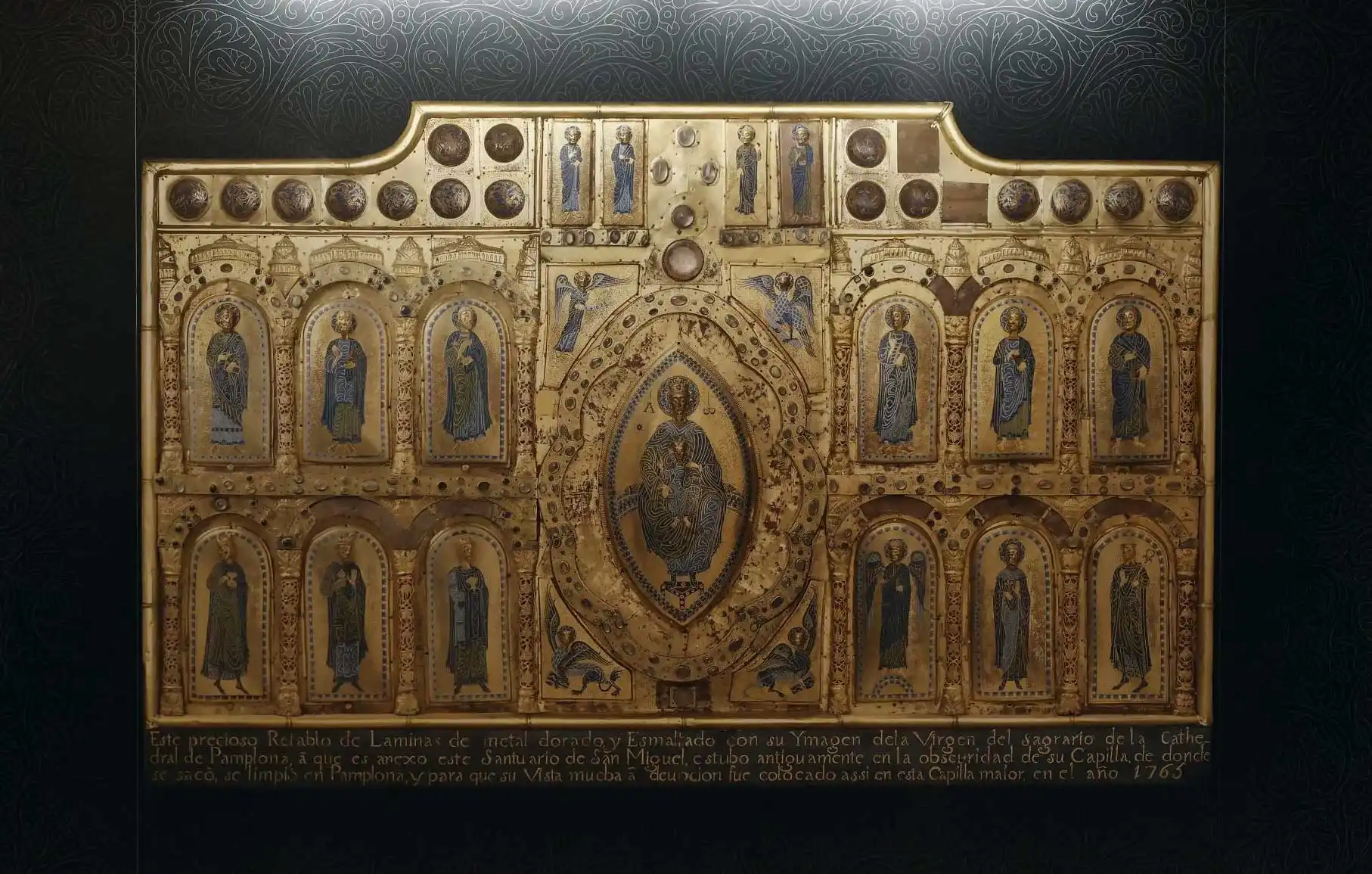
Beneath the six arches in the upper row, three on either side of the central oval, are six apostles, depicted barefoot and wearing tunics and cloaks enamelled in green and blue. Each holds a book enamelled in red, except for the apostle nearest the centre on the left, who holds a key, the identifying attribute of Saint Peter.
In the lower row, on the left, are the three Magi, each holding a golden cup. On the right are an angel standing on a cloud, a woman with a halo of sanctity, and a richly dressed man wearing a cap and holding a sceptre. The most widely accepted interpretation identifies this as the scene of the Annunciation(the Archangel Gabriel and the Virgin Mary) with the third figure being Saint Joseph.
Above the central motif, four figures representing four apostles appear on separate rectangular plaques. They are similar in dress and garments to the figures in the arcading described above, but smaller in scale. On either side of this group are sixteen medallions depicting scenes of combat between fantastical animals and vegetal motifs.
All the figures depicted on the altarpiece, except for the three Magi and the possible donor king, have halos of sanctity around their heads. The Christ Child, the apostles and the two angels are shown barefoot; however, the Virgin, in both depictions, the Magi and Saint Joseph are shown wearing shoes. The positioning of the heads in the different figures is particularly curious. While the Virgin and Child in the central motif “look” straight ahead, several other figures have their heads turned and gaze in different directions, creating striking effects in the altarpiece’s present overall arrangement. For example, the first of the three Magi has his head turned to the left and therefore appears to look outward, beyond the altarpiece, rather than towards the centre, where the Child to whom he logically offers his gift is located. Likewise, the Virgin in the Annunciation has her head turned, but not, as might be expected, towards the angel on her left; instead, she looks towards Saint Joseph. The angel, meanwhile, also has his head turned, but in the opposite direction from Mary.
Analysis carried out during the restoration work that began in 1982 revealed, through nail marks and other traces on the wooden support, that at some point before 1765 the twelve figures of similar size had been arranged differently. The six apostles occupied the upper and lower arcades on the right-hand side, while the figures of the Annunciation and the donor king, likewise arranged, filled the upper arcade on the left, and the Magi, in a different order, occupied the lower-left arcade. That may not have been the original arrangement either, and there is insufficient evidence to establish the composition intended by the altarpiece’s makers. Nevertheless, it is reasonable to think that the artists deliberately made their work more complex, and thereby displayed their skill and mastery, by differentiating each figure’s form and individualising its garments, gestures and, especially, distinctive head. They likely did so to convey that the pieces were interconnected and formed a coherent whole. It is hard to imagine that a work as carefully crafted and exquisite as this frontal was intended to produce the somewhat incongruous effects visible in its present arrangement.
 The same diversity of opinion found regarding the date of the altarpiece also appears among authors from different periods when determining its origin. Scholars such as Uranga and Íñiguez, and Gómez Moreno, maintain that it was made in the Silos school, because of its resemblance to the medieval enamelled casket preserved in the Museum of Burgos, originating from the Abbey of Santo Domingo de Silos. Others, such as Lojendio, believe that it was made in Limoges. The most recent interpretation, also put forward by Marie Madeleine Gauthier, attributes the altarpiece to a team of goldsmiths and enamel craftsmen established in Pamplona to create the work at the express commission of King Sancho the Wise and Bishop Pedro de París. The goldsmith’s workshop must have included metallurgists, founders, engravers and carpenters, as well as the highly specialised work of an enamel master from Limoges, who may have brought blocks of glass coloured intense green, red or turquoise with copper oxides, as well as others made opaque in yellow with antimony and in white with tin. Other materials used were highly valuable, including gold, copper, mercury, glass and coloured crystals, some of which may have been brought from far away, such as rock crystal from the African Atlas Mountains.
The altarpiece comprises a group of 37 enamel panels. The main figure, the Virgin and Child, occupies the central oval, or mandorla, and is complemented by the four symbols of the Evangelists. On either side, twelve arches are arranged symmetrically, in two rows of three on each side, framing a further twelve enamel figures. Between the arches are reliefs of buildings representing the Heavenly Jerusalem. At the top are four smaller figures and sixteen circular medallions, including the spaces of the other two that were not recovered after the 1979 theft. Various semi precious gemstones complete the ensemble.
The enamel pieces are made using the champlevé technique, meaning that liquid enamel was applied to tiny cells formed in copper sheets. The enamel work in the various figures is complemented by chiselled feet and hands, as well as by the projecting relief of the chiselled heads, made of gilded copper with enamelled eyes, giving the whole an extraordinary sense of depth. The exquisite enamelling work combines colours beautifully, using different shades of blue alongside green, white, black and red.
In the 18th century, the prior of Belate, Juan Lorenzo de Irigoyen y Dutari, who later became Bishop of Pamplona, oversaw the cleaning of the frontal. In 1765, the frontal was taken to Pamplona, where the silversmith José de Jirau cleaned its enamels, gemstones and other elements, and reassembled it “as before, with its new surrounding moulding.” This information, provided by Goñi Gaztambide, resolves the confusion created by Arigita’s claim that the silversmith Manuel Beramendi had restored the frontal. Beramendi only produced an engraving of it. It also clarifies that the arrangement remained unchanged, with no pieces removed or added, and that only the moulding surrounding the work was incorporated. This is supported by a document from 1666 commissioning a wooden altarpiece from José de Huici e Ituren, which was to house the frontal, “fitting into it the altarpiece now found in the said chapel, which is an apostolate with an image of the Mother of God,” apparently confirming that the frontal already had the same arrangement it has today.
The frontal returned to Aralar on the shoulders of eight men, who carried it from Zamarce. It was no longer placed in the Sanctuary chapel but was set into an altarpiece in the presbytery of the central nave. This action is recorded in the inscription at the base of the frontal: “This precious Altarpiece of gilded and enamelled metal sheets, with its image of the Virgin of the Tabernacle of Pamplona Cathedral, to which this Sanctuary of Saint Miguel is attached, was formerly kept in the darkness of its chapel. It was removed from there and cleaned in Pamplona, and so that its sight might inspire devotion, it was placed in this main chapel in the year 1765.”
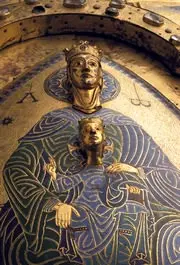
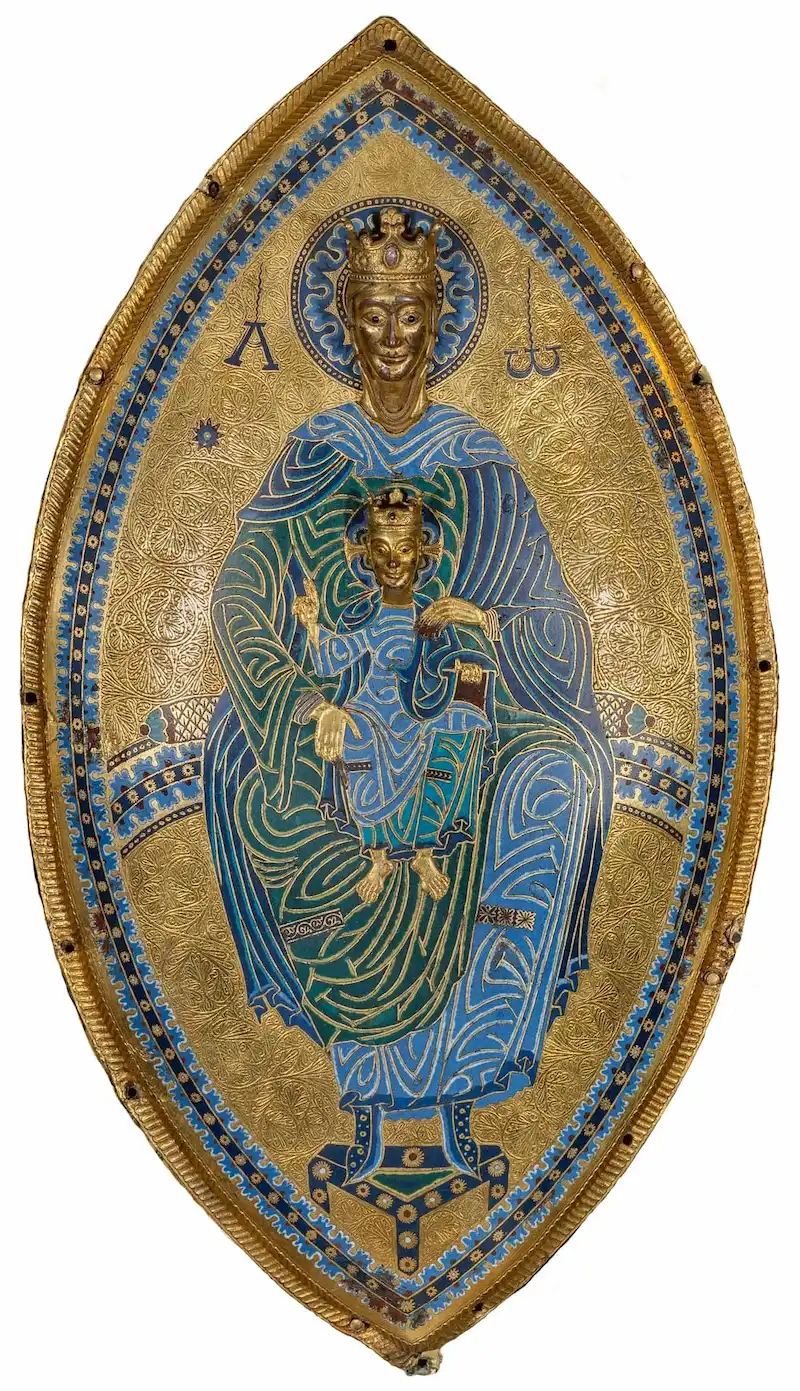
The central motif contains a theophany of the Incarnation, formed by the frontal image of the crowned Virgin Mary, seated and holding the Christ Child on her lap. The Child adopts a majestic pose, wearing a crown, blessing with his right hand and holding the Holy Scriptures in his left. Mary supports the Child with her hands at his left shoulder and right knee, with the Child’s head at the level of the Virgin’s breast. Both wear tunics in different shades of green and blue, their folds rendered in gold. Other notable elements include the alpha and omega on either side of the Virgin’s head, the Star of the Epiphany depicted beneath the alpha, the artistic footstool on which Mary’s feet rest, the cylindrical cushion supporting the Virgin’s back and visible at both ends, and the decorative Greek key patterns that form the oval, the arch on which the Virgin is seated, and her halo of sanctity.
The oval is completed at its four corners, forming a rectangle, by four enamel plaques representing the Tetramorph, or symbols of the four Evangelists. Arranged from left to right and from top to bottom, they are Saint Matthew, an angel; Saint John, an eagle; Saint Mark, a winged lion; and Saint Luke, a winged ox. The angel holds a scroll, or phylactery, bearing the signs AIO:SB, in which various scholars have sought, with contradictory results, clues to the date and authorship of the altarpiece. Father Tomás de Burgui interpreted them as Anno Christi 1028, while Arigita believed they identified the work’s creator. The latest and most widely accepted interpretation was proposed by Isidoro Ursua Irigoyen in an article published in the Government of Navarre’s journal Príncipe de Viana in 1992. He argued that they represent the abbreviated name of Christ between the Alpha and Omega, an allusion to the Book of Revelation.
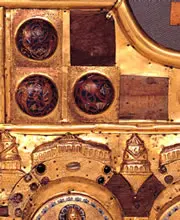 On the night of 25 to 26 October 1979, a gang of thieves acting on the orders of the notorious international art trafficker Erik “the Belgian” stole the enamelled frontal. Several people had hidden in the church’s confessionals during the afternoon and, during the night, forced open the glass display case installed in 1965 to protect the enamelled frontal. They then tore the 39 enamel pieces from their wooden support, one by one, along with several columns and arches from the surrounding decoration.
The theft devastated the sanctuary’s custodians and caused profound sorrow among those devoted to the sanctuary and throughout society at large. The authorities of Navarre mobilised to pursue any lead that might result in the recovery of Aralar’s principal artistic treasure. Police specialists in art thefts developed the theory that the perpetrators might belong to an international gang and had most likely crossed the French border on the night of the theft to evade the Spanish police.
In 1980, the Príncipe de Viana Institution, the cultural body of the Provincial Council of Navarre, led by architect Fernando Redón, prepared a documentary dossier on the stolen altarpiece. It contained numerous photographs of its individual pieces and details, as well as texts in Spanish and English, titled The Robbery of the Retable of Saint Miguel of Excelsis in Navarre. Distributed through Interpol to police offices in more than twenty countries, it targeted those where illegal trafficking in ancient works of art was most prevalent.
The first results of the investigation came on 5 March 1981, when French police seized twenty small pieces from the altarpiece in Paris. They confiscated them from Spanish citizen Carlos Paz Ibaseta as he was placing them in his car. His arrest also led to the arrests of José Antonio Ponz Gómez and Madrid antiquarian Ignacio Rodríguez Flores. Once their authenticity had been confirmed, the pieces, the four small figures from the upper section and sixteen of the eighteen medallions that crown the altarpiece, were brought to the Museum of Navarre on 26 May 1981 by Jesús Malón, the Provincial Deputy for Culture. The discovery opened the door to optimism about the complete recovery of the enamelled frontal.
On 11 July of the same year, a joint operation by the Italian and Spanish police resulted in the recovery of the altarpiece’s principal pieces and the arrest of several members of the gang known as the “Marseilles clan.”
The enamel pieces were handed over to the Spanish Embassy in Rome and flown to Madrid on 20 November. There, they were received by the Minister of Culture, Iñigo Cavero, who handed them over at Barajas Airport to Juan Manuel Arza, President of the Provincial Council of Navarre. Arza then transported them, in the same three red suitcases in which they had arrived from Rome, in the boot of his official car to the Museum of Navarre. In the following days, crowds of visitors passed through Room 31 of the Museum of Navarre, where the recovered treasures were temporarily displayed: fifteen enamel pieces, namely the central mandorla of Santa María del Sagrario, the four Evangelist symbols, five apostles, two Magi, the two Annunciation panels and the donor king, as well as sixteen small columns. Only two enamel pieces, an apostle and a Magus, and two circular medallions remained missing to complete the ensemble.
In the following months, after the arrest in Barcelona on 28 January 1982 of Eric “the Belgian,” an international art trafficker, the leads for finding the remaining pieces pointed to the Belgian city of Ghent. The Spanish Embassy in Belgium recovered the enamel plaque depicting an apostle on 8 March, and it was handed over to the Provincial Council of Navarre in Madrid on 9 June that same year. In April 1986, the only remaining figure, a Magus, was recovered in the French city of Montpellier.
Following the recovery of most of the pieces, a full restoration was carried out at the Museum of Navarre. Before the frontal returned to the sanctuary, an exhibition on medieval enamels from Navarre was held, with the altarpiece as its principal work. It was displayed in Madrid in April 1982, at the inaugural exhibition of the Caja de Ahorros de Navarra exhibition hall, and in the following months in Pamplona and Tudela.
Once the restoration was completed, the altarpiece was displayed again at the Museum of Navarre from 26 March to 7 April 1991. On 20 May that year, it was permanently reinstalled in the Sanctuary. Román Felones, the Navarre Government’s Minister of Culture, Jesús María Omeñaca, the Archbishopric’s delegate for Sacred Art, Inocencio Ayerbe, the Sanctuary’s minister, and municipal representatives of Uharte Arakil attended the modest but joyful ceremony marking the handover and return to the Sanctuary of its principal object of worship, the enamelled altarpiece of Santa María, a masterpiece of medieval enamelling made as an altar frontal in the 12th century.
The gaps still visible in the altarpiece, marking the absence of two medallions and six small sections of gilded arcading, are the only pieces that were not recovered. They are the fortunately minor trace of the ordeal suffered by this magnificent frontal between 1979 and 1982, events that kept lovers of the sanctuary and Navarrese art in suspense. They also helped ensure that this true treasure, now displayed behind robust bulletproof glass, is valued and appreciated as it deserves.
On 30 December 1996, the Government of Navarre declared the Romanesque enamel altar frontal from the Sanctuary of Saint Miguel of Aralar a Cultural Interest Asset by Regional Decree, recognising it as one of the most important works of medieval European enamelling.


